
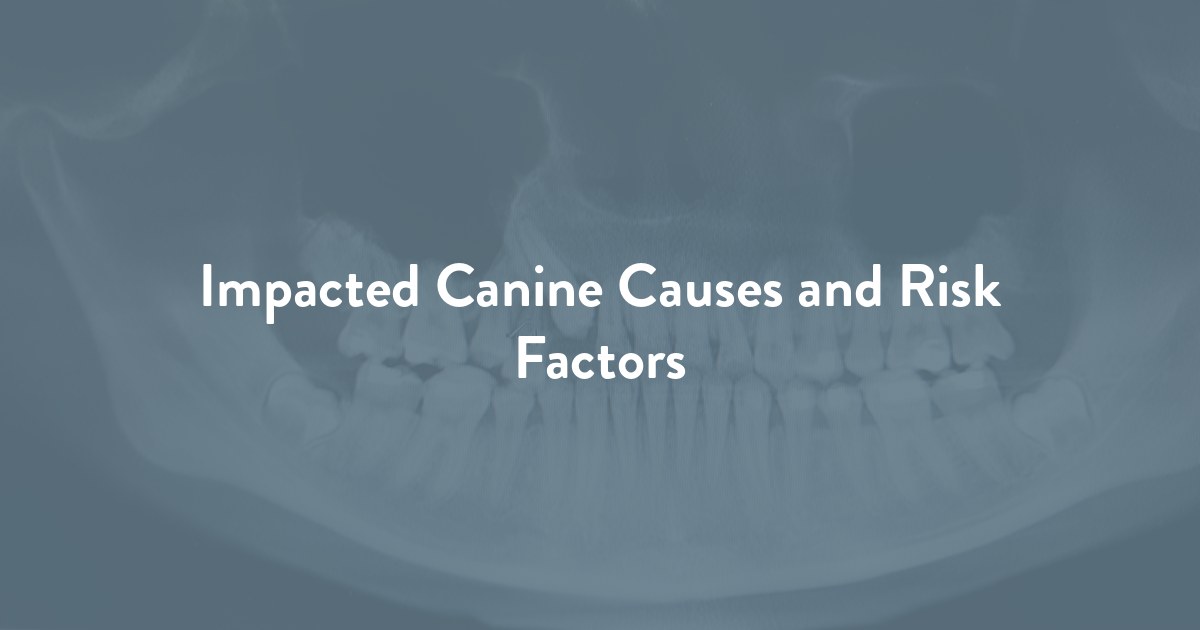
Canine teeth are the second most commonly impacted teeth, right behind wisdom teeth. When they don't come in properly, it creates problems for your smile and long-term oral health.
Most people don't realize a canine tooth is impacted until a dentist spots it on an X-ray. By that point, the tooth may have been stuck in place for years without causing obvious discomfort. That quiet development is exactly what makes routine dental checkups so important.
Concerned about a canine tooth that hasn't come in? Contact Oklahoma Dental Implants & Oral Surgery to schedule a consultation.
What Causes a Canine Tooth to Become Impacted
Genetics plays a role in whether a canine tooth becomes impacted. If your jaw is naturally narrow or your dental arch doesn't leave enough room for each tooth to erupt in sequence, the canines are often the ones that end up without a clear path.
Lack of space is one of the most common causes our oral surgeons see. When the arch is crowded because of jaw size or the positioning of neighboring teeth, a canine may have nowhere to go.
Other factors can contribute as well. A baby tooth that stays in place too long can block the permanent canine's path entirely. An extra tooth, called a supernumerary tooth, can do the same thing. Both are straightforward to identify with imaging, which is why early screening matters.
How Impacted Canines Are Usually Noticed
You may not feel anything at all, and that's actually common with this condition. The absence of pain doesn't mean everything is fine — it means the problem tends to go undetected without routine dental care. Our surgeons are trained to identify impacted canines on imaging before symptoms ever develop, which is precisely when treatment is most effective.
A few signs are worth raising with your dentist. If a canine never appears where it should, or if there's a noticeable bulge in the gum tissue near the upper arch, those are worth mentioning. Sometimes a nearby tooth has shifted slightly because of the blockage.
In many cases, the condition is identified through X-rays before you notice anything unusual. Catching it early, before the tooth has been stuck for too long, opens up a wider range of treatment options.
What Happens If It's Left Untreated
An impacted canine that goes unaddressed can begin to affect the roots of adjacent teeth over time. This pressure can cause resorption, meaning the roots of nearby teeth gradually break down in response to the force.
The surrounding gum tissue can also be affected. Gum disease is more likely to develop in areas where a tooth pushes against tissue or crowds the arch without a clear eruption path.
Timing matters here. The longer a canine tooth remains impacted, the harder it becomes to guide it into position. Treatment that might have been straightforward at a younger age can become more complex if left untreated for years.
Treatment Options Once It's Identified
Treating an impacted canine is a coordinated effort between an oral surgeon and an orthodontist, and that collaboration is what produces reliable results.
Our oral surgeons handle the surgical exposure of the tooth, while the orthodontist manages the alignment work that follows. Once the tooth is exposed, a small orthodontic bracket is bonded to it. That bracket connects to the orthodontic appliances already in place, allowing gentle, controlled force to gradually guide the tooth into its correct position in the arch.
Treatment varies depending on where the tooth is positioned, how long it has been impacted, and your overall oral health. Every case is evaluated individually.
Why Oklahoma Dental Implants & Oral Surgery Is the Right Team for This
Catching an impacted canine early, before it affects surrounding teeth or complicates treatment, is one of the most valuable things a skilled evaluation can offer. That's what we set out to provide at every consultation.
At Oklahoma Dental Implants & Oral Surgery, patients across Norman, Mustang, Edmond, and Lawton have access to that kind of thorough assessment. The team includes Dr. Seth Brooks, Dr. David Miller, Dr. Jeremy Edwards, Dr. Paul Wood, and Dr. Lauren Lunday, oral surgeons working across four locations. That reach means you can be seen at a location convenient to you, and complex or multi-stage cases are handled within a single, coordinated practice.
Our doctors offer one of the broadest scopes of oral surgical care in Oklahoma, spanning full oral and periodontal surgical services alongside facial cosmetic procedures. That depth of experience informs how our team approaches every case, including impacted canines that require careful planning.
If you or your child may have an impacted canine, early evaluation can make a real difference. Reach out to schedule a consultation at the location most convenient for you.


